

Enterprise UX
I mapped how work moved between roles before anyone designed a screen
UX design and research for SAP programs at Cargill, Ecolab, and Entegris.
Results at a glance
Workshops before design
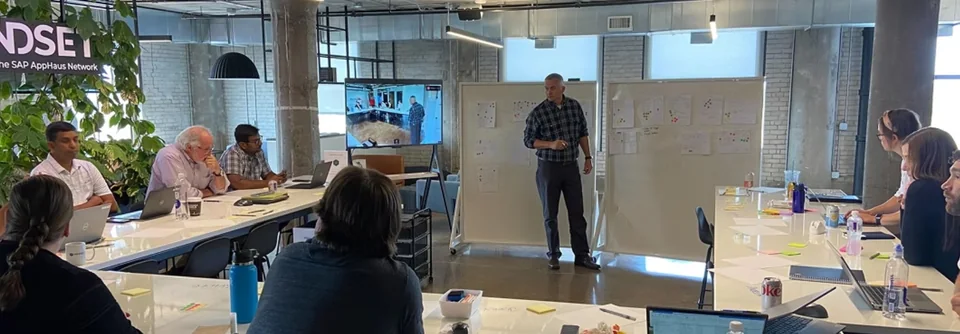
In all three engagements, the first deliverable was a shared view of the process: who does what, where work passes between people, and which problems matter most.
Problem & stakes
Each client had complex SAP processes with no UX foundation.
All three engagements began with the same gap. The SAP processes had been built around systems, with little attention to the people using them.
At Cargill, the users of a five-role approval process for financial instrument master data had never been identified. At Ecolab, territory representatives, account managers, and approvers across several divisions handled about 50,000 contract changes a year in disconnected workflows. At Entegris, plant floor work depended on paper worksheets, Excel printouts, and AS/400 screens.
Process
Each engagement started with the people involved, before any design work.
Cargill: mapping the five roles
I facilitated a full-day workshop with stakeholders representing all five roles: Requestor, FI Approver, Maintainer, Functional Approver, and Viewer. Dot voting made priorities explicit without lengthy debate, and flow mapping showed how work passed from one role to the next. I followed the workshop with user research, role-specific flows, and interaction prototypes for the engineering team.
Ecolab: comparing concepts
I joined after discovery was complete and was responsible for the Frame phase. In design studio sessions, I kept competing concepts visible side by side so that assumptions surfaced before anything was built. The group then agreed on a single framework, and I delivered interaction prototypes.
Entegris: setting priorities and anti-goals
With a junior designer, I mapped current-state journeys for putaway, receiving, and cycle counting, and summarized the findings in a 2x2 prioritization matrix. Before ideation, we agreed with stakeholders on anti-goals: no custom workarounds, no undefined roles, and no scope expansion.
Trade-offs
At Ecolab, the client chose the slower approach.
One Ecolab stakeholder objected to a design thinking session. In her view, the work had already been done, and the session would be a waste of time. I told her that the session was optional. We could instead use the traditional approach, in which a designer builds prototypes from the business requirements and the group reviews them. I also explained that this approach would take longer: a design thinking session takes a couple of hours, and a prototype is usually ready the next day. The team chose the traditional approach. By my estimate, the review cycles took at least twice as long.
Ecolab’s divisions also had different interests. The design studio sessions allowed participants to evaluate concepts on their merits, separately from the question of which division each concept favored.
At Entegris, the junior designer facilitated the client workshop, his first. Beforehand, I helped him prepare and reviewed the key points with him. During the workshop, I was in the room to check in with him, help with timing, and provide support. This took time away from my own deliverables, but the client had two practitioners in the room.
Outcome
The work gave each client’s team a foundation to build on.
Cargill: five roles were identified and documented for the first time, with flows for submission, validation, approval, and status tracking. The Cargill projects I worked on went into production.
Ecolab: the divisions agreed on a consolidated framework and interaction prototypes for a platform that serves about 250 users.
Entegris: the client received journey maps, a prioritized problem set, agreed goals, and tablet interaction concepts. The junior designer completed his first end-to-end client engagement.
Reflection
I would make the Entegris coaching approach repeatable, with defined coaching points for each phase, clear criteria for when to step in, and a standard debrief after each stakeholder session.